
See the biggest culprits behind every delayed projects, and how...
October 20, 2026
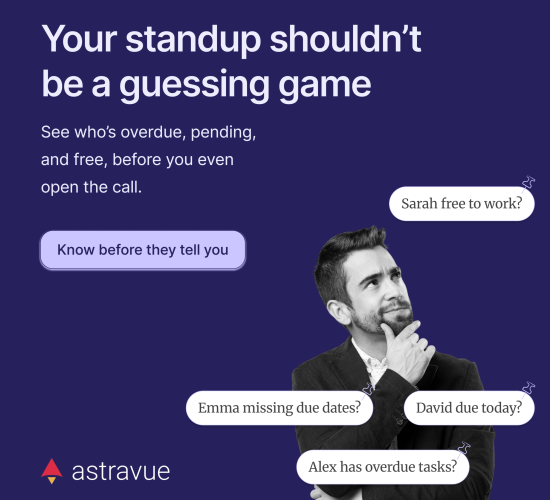
Daily standups fail when they turn into status theater instead of quick syncs, and the real cause is usually invisible.
Scrum masters and managers cannot see who is overloaded, who is idle, and what is overdue without opening five different spreadsheets first.
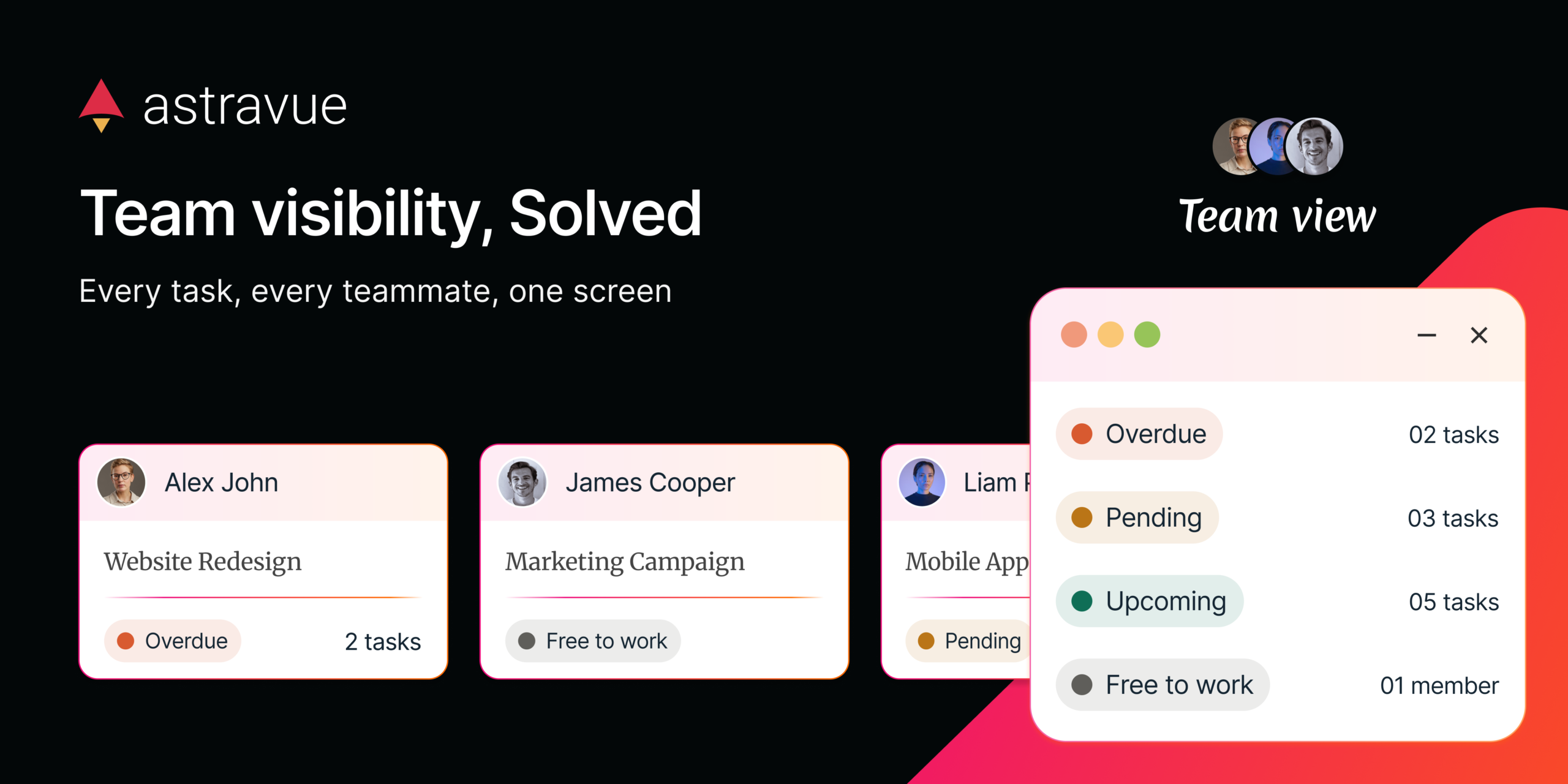
Astravue’s Team View fixes this by putting every team member’s tasks, statuses, and due dates on one screen, so standups take five minutes instead of thirty.
Matt has been a scrum master for three years.
Every morning, before his team’s 9:30 standup, he opens four tabs: one Google Sheet for the LinkedIn Leads project, one Excel file his manager insists on for reporting, one Trello board his design team prefers, and his own notebook where he scribbles down whatever doesn’t fit anywhere else.
By the time standup starts, he already knows less than half of what he needs to know. Who’s blocked? No idea, that lives in Slack DMs nobody forwarded her. Who has three overdue tasks that nobody has flagged? He’ll find out the hard way, probably during the retro.
If this sounds familiar, you are not doing agile wrong. You’re just missing visibility, and you’re far from alone.
The daily standup was supposed to be the leanest ceremony in agile. Fifteen minutes, no chairs, no slides, just a quick sync.
In practice, research on standup meetings found that standups designed to run fifteen minutes now average around thirty, and a broad share of recurring meetings blow past their time box entirely.
The reason isn’t that teams talk too much. It’s that the standup becomes the only place where status actually gets surfaced, because nobody has a shared view of it anywhere else.
Every “what did you work on yesterday” turns into a mini status report because the manager or scrum master genuinely doesn’t know.
This is expensive.
Asana’s State of Work Innovation report found that time lost to unproductive meetings has roughly doubled since 2019, now costing employees around five hours a week.
And a widely cited Harvard Business Review survey of senior managers found that 71 percent say their meetings are unproductive and inefficient, with a large share of status-style meetings seen as something that could have been handled without a meeting at all.
Translate that into a scrum team of eight people, and one broken standup ritual can quietly cost you the equivalent of a full workday, every single week.
Ask any scrum master or PM what they do right after standup, and most will tell you some version of the same thing.
They open a spreadsheet to update statuses, then another to check due dates, then a third to see who’s free for the next sprint.
This isn’t a small annoyance. Original research from Smartsheet found that 94 percent of professionals still use Excel regularly and 61 percent use Google Sheets, but almost none of them rely on just one tool.
In fact, 89 percent said they now juggle more than one system to manage their work.
Separately, Wellingtone’s project management survey found that around half of respondents spend a full day or more each reporting cycle manually pulling numbers together, simply because there’s no single source of truth.
For a manager overseeing multiple projects, that means:
None of this is a people problem. It’s a visibility problem, and visibility problems can’t be solved with more meetings. They need a better system.
Talk to enough project leads and a simple wish list emerges. They want to see, at a glance and without opening a single spreadsheet:
That’s it. Not a new methodology, not another ceremony. Just one honest view of the team.
Astravue’s Team View takes everything scattered across sheets, boards, and Slack threads and puts it on one screen.
Instead of opening five tools before standup, a scrum master opens Team View and sees, member by member: how many tasks each person has, which are overdue, which are pending, and which are upcoming.
A dedicated filter surfaces every task without a due date, the exact kind of task that usually gets forgotten until it’s a problem. Another filter shows members with no tasks at all, so managers can spot who’s free before the sprint planning meeting even starts, not after.
Every row shows the task, the project it belongs to, its current status, and its due date, all pulled live from the actual work being done, not from someone’s memory of a conversation they had three days ago.
The daily standup isn’t broken because agile is broken. It’s broken because most teams walk into it blind, patching together visibility from tools that were never meant to talk to each other.
Give a scrum master or a manager one real-time view of who’s doing what, and the ceremony agile promised us fifteen years ago finally works the way it was supposed to.
That’s what Team View is built for. See it in your workspace under Team View in the sidebar, and see how much shorter your next standup can actually be.
Ready to stop sheet-hopping before your next standup? Try Team View today and see your whole team’s workload in one screen.
Matt still runs standup at 9:30. The difference is what happens before it.
Now he opens Team View at 9:15, filters by Overdue, and already knows exactly which two tasks need a mention.
He checks Tasks Without Due Date and catches one that slipped through, before it becomes a fire drill in week three.
He glances at Members With No Tasks and realizes Sam is free, so she assigns him to help clear the backlog instead of finding out during retro that he’d been idle for two days.
Standup itself now takes less than ten minutes. Not because the team talks less, but because nobody needs to explain what a dashboard already shows.
Why do daily standups take longer than 15 minutes?
Standups run long mainly because they end up being the only place status gets shared. Without a shared view of who’s working on what, team members end up giving full status reports instead of quick updates, which is why research shows many 15-minute standups now regularly stretch toward 30 minutes.
How many tools do project managers typically use to track work?
Research from Smartsheet found that 89 percent of professionals use more than one tool to manage work, even though the vast majority still rely on spreadsheets like Excel or Google Sheets as part of that mix.
What is a Team View feature in project management software?
A Team View is a single screen that shows every team member’s tasks across all projects, typically filterable by status such as overdue, pending, or upcoming, along with visibility into tasks with no due date and team members who are free to take on new work.
Can a tool like Astravue replace the daily standup entirely?
Not entirely, and it shouldn’t try to. The goal isn’t to remove human connection from the team, it’s to remove the guesswork. Team View means the standup can focus on blockers, decisions, and collaboration instead of status reporting.
Who benefits most from a Team View style feature?
Scrum masters, project managers, and team leads managing multiple projects or team members at once get the most value, since they’re the ones responsible for spotting overdue work, workload imbalance, and capacity before it becomes a bigger problem.
See the biggest culprits behind every delayed projects, and how...
See the biggest culprits behind every delayed projects, and how...

See the biggest culprits behind every delayed projects, and how...
See the biggest culprits behind every delayed projects, and how...