astravue

Why we built a way for Claude to ask Astravue about profit, not just progress

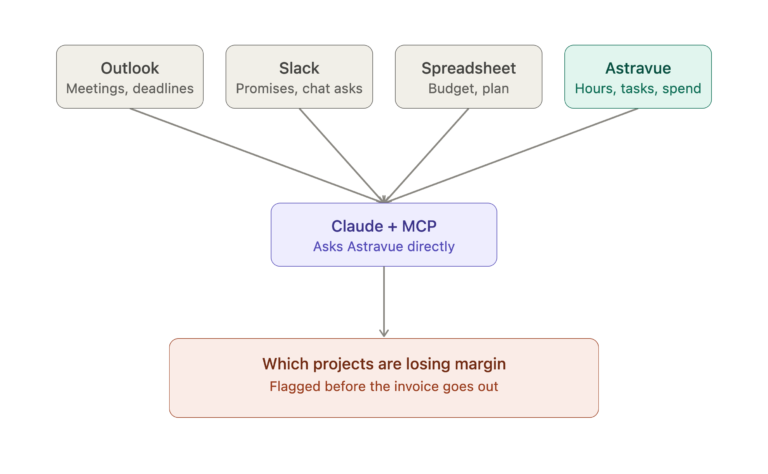
Diagram showing Outlook, Slack, and a spreadsheet feeding into Claude and MCP, alongside Astravue, to flag which projects are losing margin before invoicing.

Before Astravue existed, I was on the other side of this problem. I worked inside a service company, and later consulted for a handful of others, and I watched the same pain play out at every single one of them. The work gets done. The client is happy. And then, somewhere between the kickoff call and the final invoice, the profit quietly disappears, and nobody can point to the exact moment it happened.

It wasn’t because people weren’t tracking time. Most teams tracked obsessively. The problem was that a lot of the actual work never made it into the system that was supposed to hold it. A meeting got booked and held in Outlook, and the hour it took never turned into logged time. Scope crept in a Slack thread, someone said “sure, we can add that,” and it never became a tracked task. Someone kept their own private sense of where a project stood, in their head or a personal notes doc, and it never made it into the board everyone else was looking at. The work was real. The record of it wasn’t.

The problem was never multiple tools

For a long time, I assumed the fix meant getting Outlook, Slack, and Astravue to somehow talk to each other, reconcile all three, and produce one unified truth. That’s a much harder problem than it needs to be, and it’s not actually the one that matters. Outlook and Slack were never going to be the record of what got billed. They were just where the work happened before it either made it into the system or didn’t. Astravue was always the one place built to hold the actual hours, the actual tasks, the actual spend. The problem was never that the truth was scattered across four places. It was that nobody had time to sit down and ask the one place that mattered the right question.

I remember sitting in a Friday review, trying to figure out why a project that looked completely healthy on the board had somehow lost money, and realizing the honest answer was that nobody had actually checked. The status was green because nobody had marked it red, not because anyone had verified the margin. That distinction cost real money, more than once, at more than one company. It wasn’t a one-off mistake. It was a structural gap, and every service business I saw was carrying some version of it.

So when we connected Astravue to Claude through MCP, we weren’t trying to teach Claude to read Outlook or Slack. We built a way for Claude to interrogate Astravue directly, and find the exact shape of what those meetings and Slack threads left behind:

  1. Once a week, someone can ask Claude to compare billable and non-billable time across every active project, and it flags the ones carrying the highest non-billable effort, the early warning for margin loss, weeks before it would show up on an invoice.
  2. They can ask Claude to find time entries with no task attached to them, and active tasks with no time logged this week. That’s the exact shadow of a meeting that happened but was never logged, or a piece of scope that got agreed to in passing and never turned into tracked work.
  3. They can ask Claude to find projects with tracking problems: missing owners, no recent updates, overdue tasks with no due date. The quiet signs that a project has stopped being managed, not just delayed.
  4. All three answers come straight from what’s actually logged in Astravue. No export. No manual calculation. No decision made three weeks late because someone finally got around to building the spreadsheet.

Why we wanted this inside Claude, not just inside Astravue

Outlook and Slack are where the actual work happens, meetings get booked, scope gets discussed, promises get made in passing. Neither one was ever built to be the record of what got billed or delivered. Astravue was. The gap was never that Astravue lacked the truth. It was that nobody had time to sit down and ask it the right question, whether that hour ever became a task, whether this project has actually been touched this week, whether the thing agreed to in a Slack thread ever showed up as tracked work.

That’s why Claude doesn’t need to read Outlook or Slack to be useful here. It needs to interrogate Astravue itself, and find the precise hole those conversations left behind. Claude doesn’t have to see the meeting to know something happened there. The missing task is enough. Claude doesn’t have to read the Slack thread to know scope crept. The untracked hours are enough.

Today, that connection is live.

Astravue is now available as a verified MCP server on Claude. You don’t need to export anything, build a new dashboard, or wait for the monthly report. If you already use Claude, you can connect it to your Astravue account and ask it the question we used to only ask on the worst Fridays: which of our projects are actually still profitable, right now, and where did the untracked work go.

We’re not claiming this catches everything. Some weeks the flagged project turns out to be fine. But the shift we were chasing was never a grand unification of every tool a team happens to use. It was timing, finding out about a margin problem on a Tuesday, with time to fix it, instead of finding out on invoice day, with nothing left to do but discount it.

We built this because we lived the alternative. Now you don’t have to

Keep Reading