
See the biggest culprits behind every delayed projects, and how...
November 3, 2026
Nobody buys project management software because they want more features. They buy it because they want fewer bad surprises and more projects that land on time and on margin. That is especially true of professional services project management software, where every hour and every date has a price. It is why we built Astravue around outcomes first.
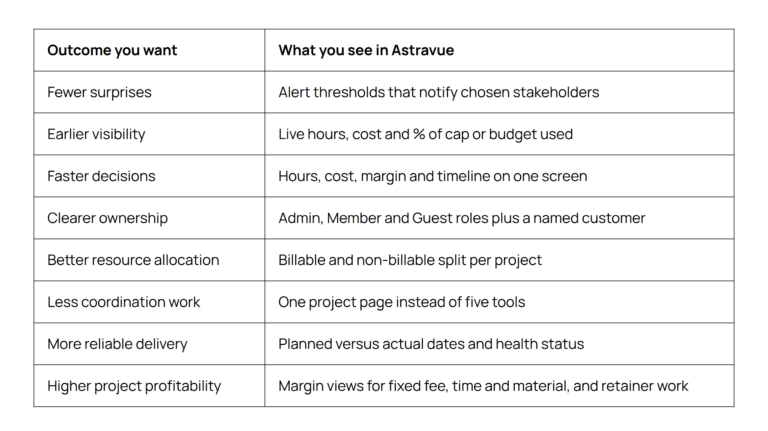
Astravue is built for medium and large companies with dedicated project managers and service delivery teams. When those leaders tell us what they want from a tool, the list is always some version of this:
Every feature in Astravue has to push at least one of these forward. If it does not, we question why we are building it.
Here is a story most product teams will recognize. A team spends a full quarter building a detailed Gantt dependency editor because three large prospects asked for it in demos. It ships. Six months later, usage data shows that fewer than one in twenty active projects ever opened it.
What customers actually wanted was not a dependency editor. They wanted to know, earlier, when one late task would push the go-live date. The feature answered the request. It missed the outcome.
This is a composite example drawn from common product situations, not a single named company.
The rest of this article walks through each of the eight outcomes, why it matters to delivery leaders, and exactly how Astravue helps you get there.
Software teams love shipping. Customers love outcomes.
The gap between the two is where most project management tools quietly lose their value.
Put those together and you get a familiar picture. Teams pay for software full of features they never touch, then spend hours moving between that software and five other tools to piece together a status update.
The fix is not fewer features for the sake of it. It is a stricter question for every feature: which outcome does this improve, and how will we know?
A surprise is just bad news that arrived late. The customer escalation, the blown budget, the missed launch: almost all of them were visible somewhere, to someone, weeks earlier.
Good software reduces surprises by watching the numbers people forget to check. For example, a time and material project with a 200-hour cap should not wait for the monthly review to reveal that 184 hours are gone. It should alert the account owner and delivery lead the moment usage crosses an agreed threshold, say 80%.
Every project carries an alert threshold, such as 80% of the hours cap or contract value. When it is crossed, PM should notify the stakeholders you picked, like the account admin and delivery lead, so nobody learns about it from the client. A Health field (On-track or At-risk) sits right next to Status, so a project cannot look “Open and fine” while it is quietly burning budget.
Visibility is only useful if it comes early enough to act on. A report that tells you the project is over budget after it closes is history, not visibility.
Many teams still build status by hand. Wellingtone’s research found 47% of organizations lack access to real-time project KPIs, and half spend at least a day a month manually collating status. (Breeze summary of Wellingtone data)
A simple test: Can a delivery head see, in under a minute, which five projects need attention this week and why? If the answer needs a spreadsheet and a meeting, visibility is too late.
Delivery heads love to see the real position without waiting for a monthly report or a spreadsheet.
Many projects do not slow down because people stop working. They slow down because a decision is waiting on someone, and nobody can see how long it has been waiting.
In a McKinsey survey of more than 1,200 managers, 61% said at least half of their decision-making time is ineffective, and fewer than half said decisions were timely. McKinsey estimated this costs a typical Fortune 500 company about 530,000 manager-days a year. (McKinsey Quarterly)
Software cannot make the decision. It can make the waiting visible: what is pending, who must decide, what it blocks, and what each extra week costs.
A great Project Management tool puts the facts for a decision in one place: hours, cost, margin and timeline on the same screen. Threshold alerts go straight to the people who can act, so a call on scope, budget or a change request happens when the warning fires, not three meetings later.
When everyone owns a problem, nobody does. Clear ownership means one name next to every task, risk, blocker and decision.
This is a wider workplace problem, not just a project one. Gallup found that in 2024 only 44% of employees strongly agreed they know what is expected of them at work, a record low, down from 55% in 2019. (Gallup)
A familiar scene: A client asks why a report is late. The developer thought the analyst owned the data. The analyst thought the PM was chasing the client for access. The PM thought it was done. Three people, zero owners.
How PM tool should delivers this: Every project names its customer and its people by role: an Admin who owns it, Members who do the work, and Guests such as client contacts. Private, invite-only projects keep access tight. Everyone can see who is accountable, and nobody can say they did not know.
In a services business, people’s time is the product. Every unbilled hour on the wrong project is margin that will never come back.
The industry is struggling here. The SPI Research 2026 Professional Services Maturity Benchmark, covering 509 firms, found average billable utilization fell to 66.4% in 2025, the lowest it has recorded and below the 70% it treats as a healthy minimum. (Rocketlane summary of SPI data)
The usual cause is not lazy teams. It is poor matching: senior people stuck on low-value tasks, juniors waiting for work, and nobody seeing next month’s crunch until it arrives.
Good PM tool splits every project’s hours and cost into billable and non-billable. You can see, project by project, where your team’s time is really going, and spot work that is eating capacity without earning revenue.
Coordination is the work about the work: chasing updates, copying data between tools, and holding meetings just to find out where things stand.
Asana’s research found knowledge workers lose about 60% of their time to this kind of work, and in companies with 5,000+ employees it rises to 63%. (Asana via Business Wire)
Every feature that adds a form to fill or a field to update should be treated with suspicion. The best project management software captures data as a side effect of doing the work, not as extra admin.
Reliable delivery means customers can plan around your dates. It is what turns a one-off project into a renewal and a reference.
SPI Research puts average on-time delivery at about 74% and describes it as stubbornly flat. (TimeLog summary of SPI data) In other words, roughly one project in four still arrives late, year after year.
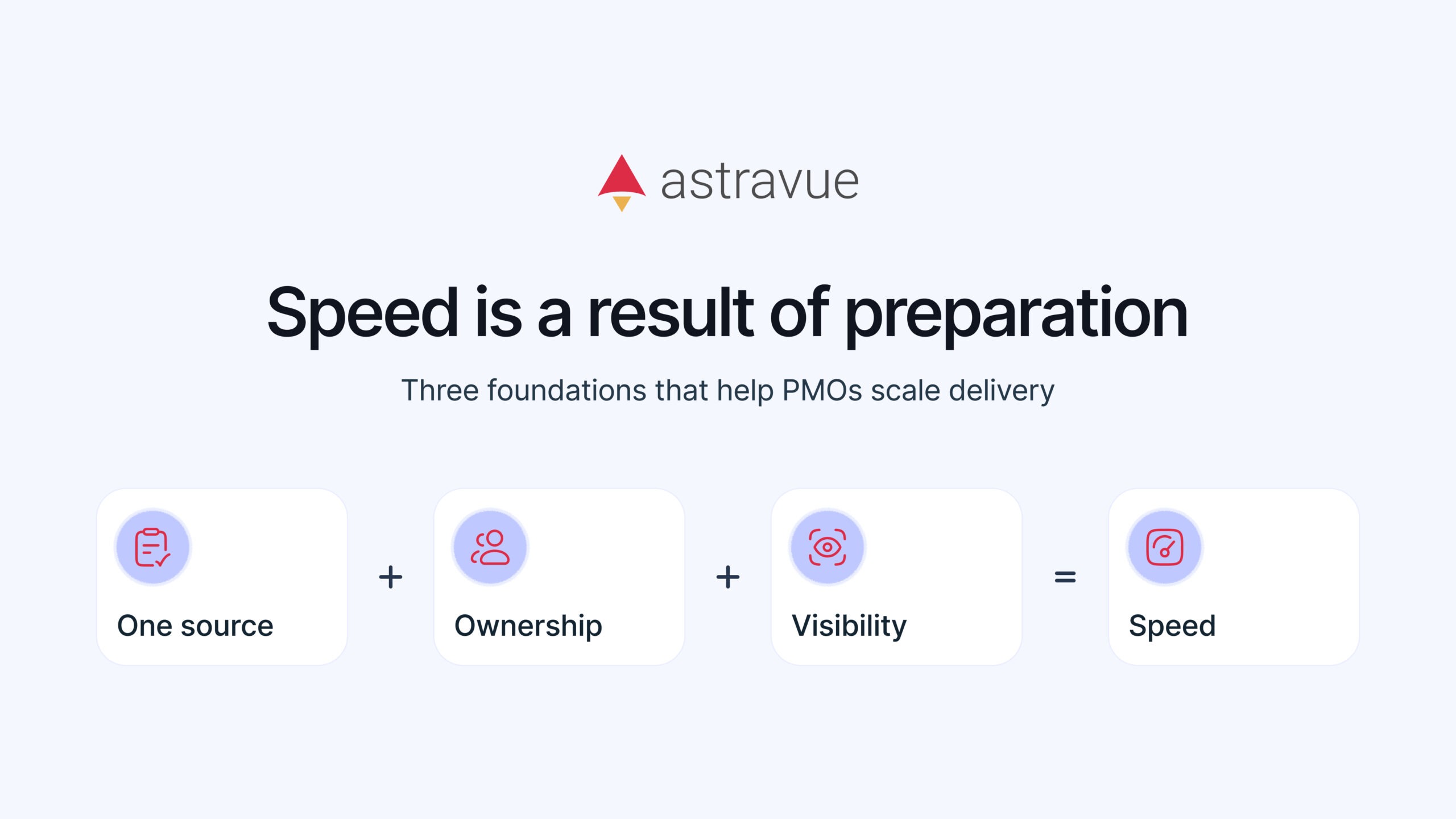
Reliability is the sum of the first six outcomes. Fewer surprises, earlier visibility, faster decisions, clear owners, the right people and less admin all add up to dates that hold.
This is where every other outcome shows up on the income statement. The gap between average and excellent firms is wide:
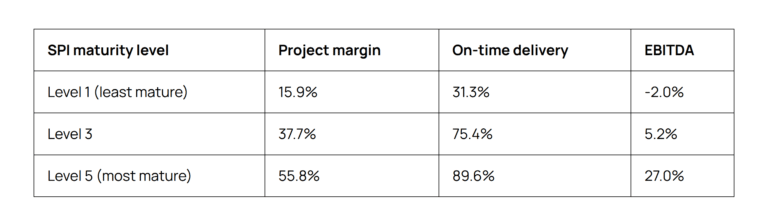
Source: Rocketlane summary of the SPI 2026 benchmark. SPI treats a project margin above 35% as a sign of healthy pricing and delivery.
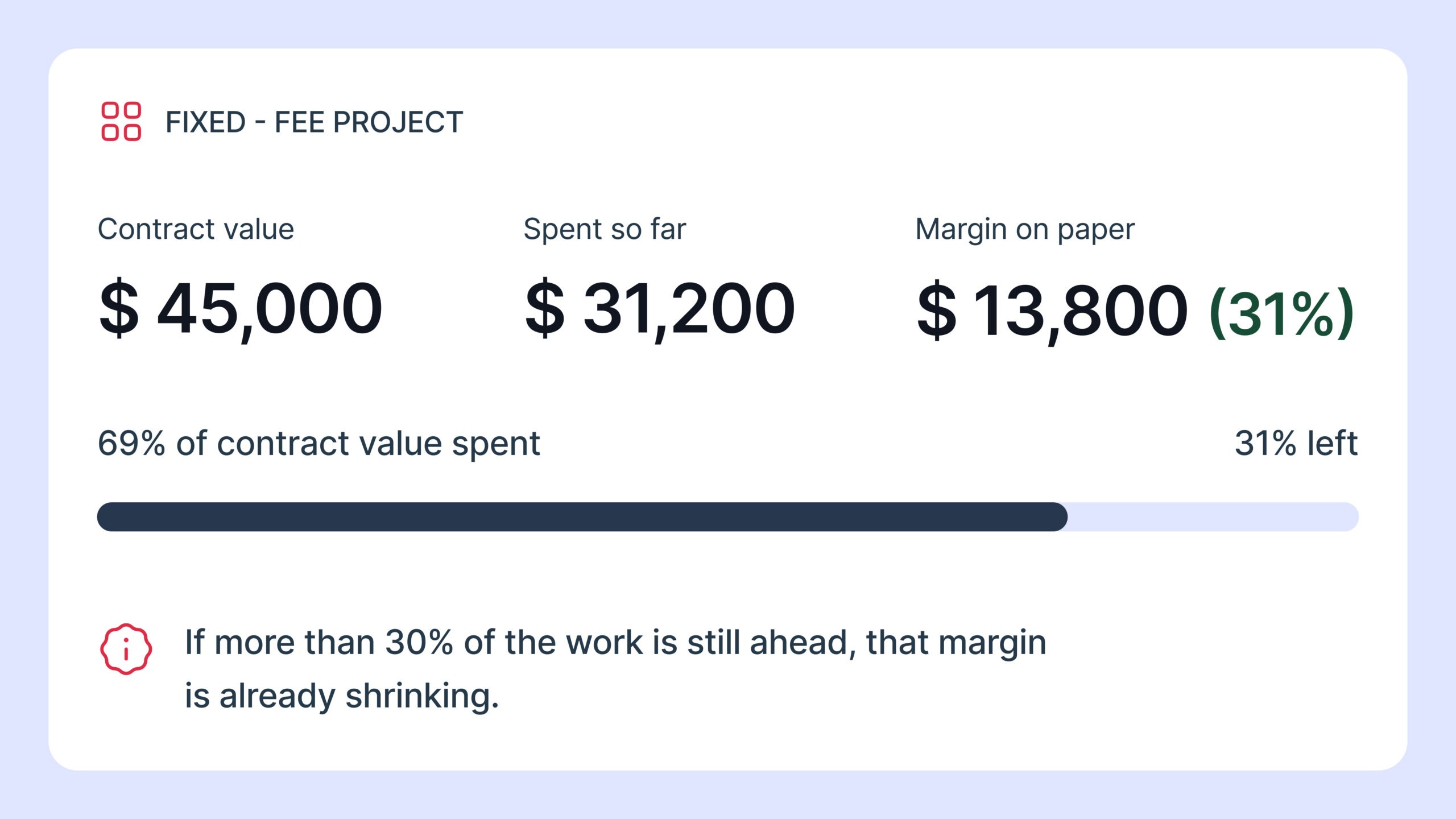
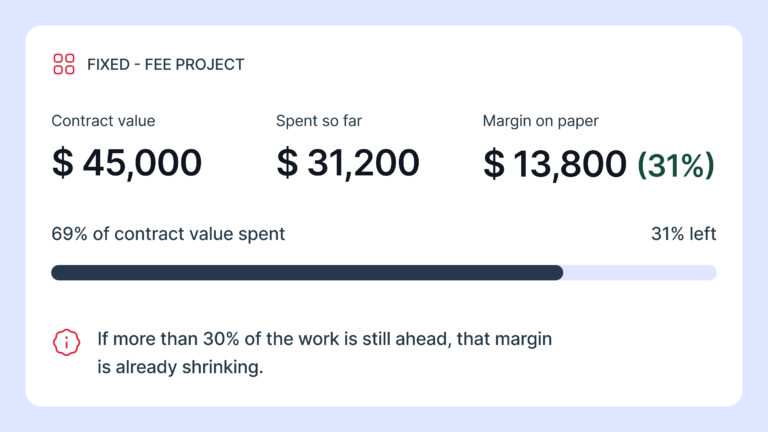
A quick example: A fixed-fee brand project is worth $45,000. The team has spent $31,200 so far, so 69% of the contract value is gone. On paper the margin is $13,800, or 31%. But if more than 30% of the work is still ahead, that margin is already shrinking. Software should flag this the day spend outpaces progress, not when the invoice is raised.
How Astravue delivers this: Astravue understands how you actually sell. Pick the project type and the financial view adapts:
That is how a delivery leader spots the $45,000 fixed-fee project above while there is still time to protect its margin.
This is where every other outcome shows up on the income statement. The gap between average and excellent firms is wide:
Before any feature goes on the Astravue roadmap, it has to pass four plain questions:
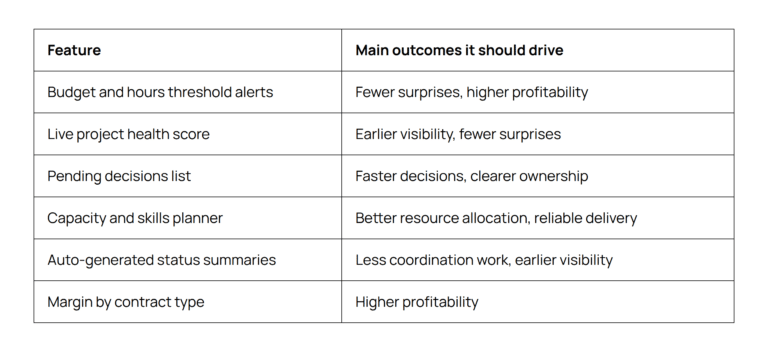
Here is how that thinking maps a few common features to outcomes:
AI is the biggest lever for several of these outcomes, especially less coordination work and earlier visibility. Gartner predicted in 2019 that by 2030, AI would take over about 80% of today’s project management tasks, mainly data collection, tracking and reporting. (Gartner)
We hold AI in Astravue to the same filter. An assistant that writes a nicer status report is a feature. AI that spots a retainer burning hours faster than planned and tells the account owner before the client notices is an outcome. That is the bar.
Most project tools were built for task tracking and had finance bolted on later. Astravue was built for service delivery from the start, so the commercial picture and the delivery picture live on the same page.
Ready to see the outcomes, not just the features?
Book a demo of Astravue and see your own projects through these eight lenses.
What is the best professional services project management software?
The best tool is the one that delivers outcomes: fewer surprises, earlier visibility, faster decisions, clearer ownership, better resource allocation, less coordination work, more reliable delivery and higher project profitability. Astravue is built around exactly these, with financial views for fixed fee, time and material, and retainer projects.
Why choose Astravue over a general task management tool?
General tools track tasks well but leave money and margin to spreadsheets. Astravue shows hours, cost, margin, health and ownership together on every project, and alerts the right people before a budget or cap is breached.
Why do so many software features go unused?
They are built to answer requests, not outcomes. Pendo found that 80% of features in the average software product are rarely or never used.
What is a good billable utilization rate?
SPI Research treats about 70% as a healthy minimum. The 2025 industry average fell to 66.4%, while the most mature firms reach 80% or more.
What is a healthy project margin for a services firm?
SPI Research uses 35% as the benchmark for healthy pricing and delivery. The most mature firms average above 55%.
How does AI improve project management?
AI is strongest at collecting data, tracking progress and reporting. Used well, it cuts coordination work and flags risks earlier, so people can spend their time on decisions.
See the biggest culprits behind every delayed projects, and how...
See the biggest culprits behind every delayed projects, and how...
See the biggest culprits behind every delayed projects, and how...
See the biggest culprits behind every delayed projects, and how...